Last updated November 3, 2026
Quick answer
In the City of Toledo, a demolition permit is not required when the structure is under 6,000 cubic feet, is not in a historic district, and has no water or sewer service. Most backyard sheds fall well under that size. A large two-car garage can land over it, and any garage with its own water or sewer line, or any building in a historic district, needs the permit no matter how small it is. Outside city limits, your own city or township sets the rules.
The three conditions that skip the permit in Toledo
The City of Toledo's Division of Building Inspection lists exactly when a demolition permit is not required. The structure has to meet all three of these at once:
- It is under 6,000 cubic feet.
- It is not in a historic district.
- It has no water or sewer service.
How to figure out the cubic feet of your shed or garage
Cubic feet is length times width times height. The city's permit application asks for the structure's length, width and height, so those three numbers are what you need either way. For a building with a peaked roof, the simplest estimate is to measure the height at the walls and at the peak and use the number halfway between them.
A few examples using that method:
- A 10 by 12 foot garden shed with an average height of 8 feet is about 960 cubic feet, far below the line.
- A 12 by 20 foot one-car garage with an average height of 10 feet is about 2,400 cubic feet.
- A 20 by 20 foot two-car garage with an average height of 10 feet is about 4,000 cubic feet.
- A 24 by 24 foot two-car garage with an average height of 11 feet is about 6,336 cubic feet, which is over the line.
Historic districts and garages with water or sewer
Size is only one of the three tests. If your property sits in a designated historic district, the small-structure exemption does not apply, and the city also requires a Certificate of Appropriateness for properties in a historic district or the Downtown Overlay District before you apply. That comes through the Plan Commission. This matters in neighborhoods like the Old West End, where a lot of the detached garages are as old as the houses.
The same goes for any shed or garage with its own water or sewer service, even a small one. Before the city issues a demolition permit, those taps have to be shut off and abandoned through the Department of Public Utilities (the city calls it a "Turn Off and Remove" plus a water and sewer kill), and the permit is only released once that is done. If you are not sure whether a line was ever run out to the building, look for a utility sink, a floor drain tied into the sewer, or a separate water shutoff inside.
Electrical is a separate question from the permit test. A garage with power should have it shut off and safely disconnected by an electrician or the utility before anyone starts pulling walls down.
What the city asks for when you do need a permit
The city describes demolition as a layered process that runs through several offices. Before applying, its demolition permit page lists these steps:
- Request a "Turn Off and Remove" for water service from the Department of Public Utilities.
- Get a Certificate of Appropriateness from the Plan Commission if the property is in a historic district or the Downtown Overlay District.
- Contact the Health Department for a rodent inspection.
- Confirm with Columbia Gas that gas service is abandoned, or request a shutoff if it is still active.
- Confirm with Toledo Edison that electric service is abandoned.
- Contact the city's Environmental Services division to check asbestos review requirements.
- Get a Toledo Tax ID number from the Division of Taxation.
- Contact the Department of Transportation if the work will interfere with the public right-of-way.
- Let the neighbors know the structure is coming down.
Applying, and what the site has to look like afterward
Applications go through the city's online permit portal, where you can also pay fees and track the permit. A paper application can be dropped off at the Division of Building Inspection, One Government Center, Suite 1600, Monday through Friday from 8 a.m. to 3 p.m. You will need the legal description and dimensions of the structure. The application fee is based on the structure's size in cubic feet, and structures with water or sewer taps also pay for the water and sewer kill. The city posts the current amounts on its demolition permit page.
Taking the walls down is only part of a permitted demolition. The city's list of requirements after the structure comes down includes these items that apply to most garage jobs:
- Walks, drives, slabs, fences and terraces outside the public right-of-way have to be removed, unless the building official decides leaving them does not create a public nuisance.
- Concrete or masonry floors below grade have to be broken up so groundwater can drain.
- Walls or footers have to come out to 18 inches below the existing grade.
- The site has to be left clean, graded to match what was there before so it does not send water onto the neighbor's yard, and seeded with grass.
- All demolition material has to go to a licensed landfill.
- The site has to be secured while work is going on, and any underground storage tank needs its own separate permit to remove.
Outside Toledo city limits
The rules above are the City of Toledo's. Perrysburg, Maumee, Sylvania, Oregon and the other cities around Toledo, along with townships like Monclova, Springfield and Sylvania Township, each handle building and demolition permits their own way. Check with your own city or township building office before you start, and have the dimensions and the utility details ready when you call, since those are the same questions most offices ask.
Also keep the building rules and the demolition rules separate in your head. Toledo's 200 square foot cutoff that you may have seen for sheds applies to building a new accessory structure, not tearing one down. For demolition, the 6,000 cubic foot test is the one that counts inside city limits.
Having Powerhouse take it down
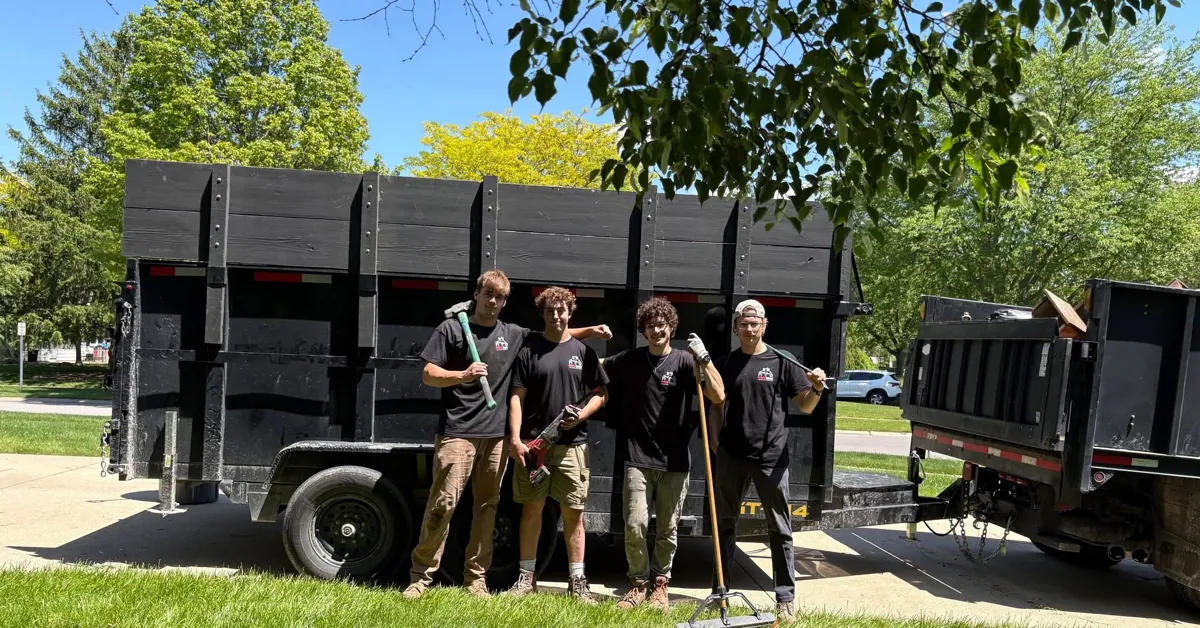
Powerhouse is licensed in Ohio, and when a demolition permit is needed, we pull it and handle the paperwork as part of the job. Our shed and outbuilding demolition crew takes down wood, metal and vinyl sheds, playsets, greenhouses and small barns, and can break out the concrete pad and dig out anchors or footings so you are left with clean ground. Most shed teardowns are a half-day job, and same-day or next-day scheduling is often available around Toledo.
For garage demolition, most single and two-car detached garages come down in a day, and we can remove the slab and footings too if you plan to rebuild or put the space back to lawn. If the garage is still full, we clear out the shelving, old tires, paint cans and boxes before the teardown, so it all goes in one trip. Attached garages share a wall and roofline with the house, so we look at those in person first.
Demolition and haul-away come as one job, and we load every piece before we leave. If you only have a few small pieces to get rid of yourself, our guide to bulk pickup in Toledo covers what the city will take at the curb. See our Toledo demolition page for the neighborhoods we cover, or contact us for a free estimate.
Need a hand?
Powerhouse handles shed & outbuilding demolition across Toledo & Northwest Ohio. Call (419) 928-5481 or get a free estimate online.